
Market-proof your freight plan.
Reliable capacity, better service, lower spot exposure, and sustained cost improvement, regardless of where the market cycle goes next.
Support at every phase of your procurement cycle.
Leaf is not a once-a-year event. Whether you are building the bid, running it, awarding it, or living with last year's awards, there is a place to start.
Build lanes carriers want to win
Leaf's proprietary power lane clustering improves the density and predictability of your bid items. That enables higher-quality proposals from carriers, and substantially reduces the long tail of low-volume lanes that drives spot exposure.
- Point-to-point lanes into one market become a single, denser bid item
- Volume that carriers can plan assets and drivers around
- Fewer lanes left to the routing guide and the spot market
Drive improved pricing and stability with packages
Carrier digital twins are matched to your network to identify where your freight benefits the carrier's operations. Carriers can then propose packages of volume with dedicated-like economics, driving cost and service stability.
- Invite-only, with the asset-based carriers you choose
- Proposals built as constellations of correlated lanes, not one lane at a time
- Dedicated-like economics without managing a fleet
Stress-test awards before you make them
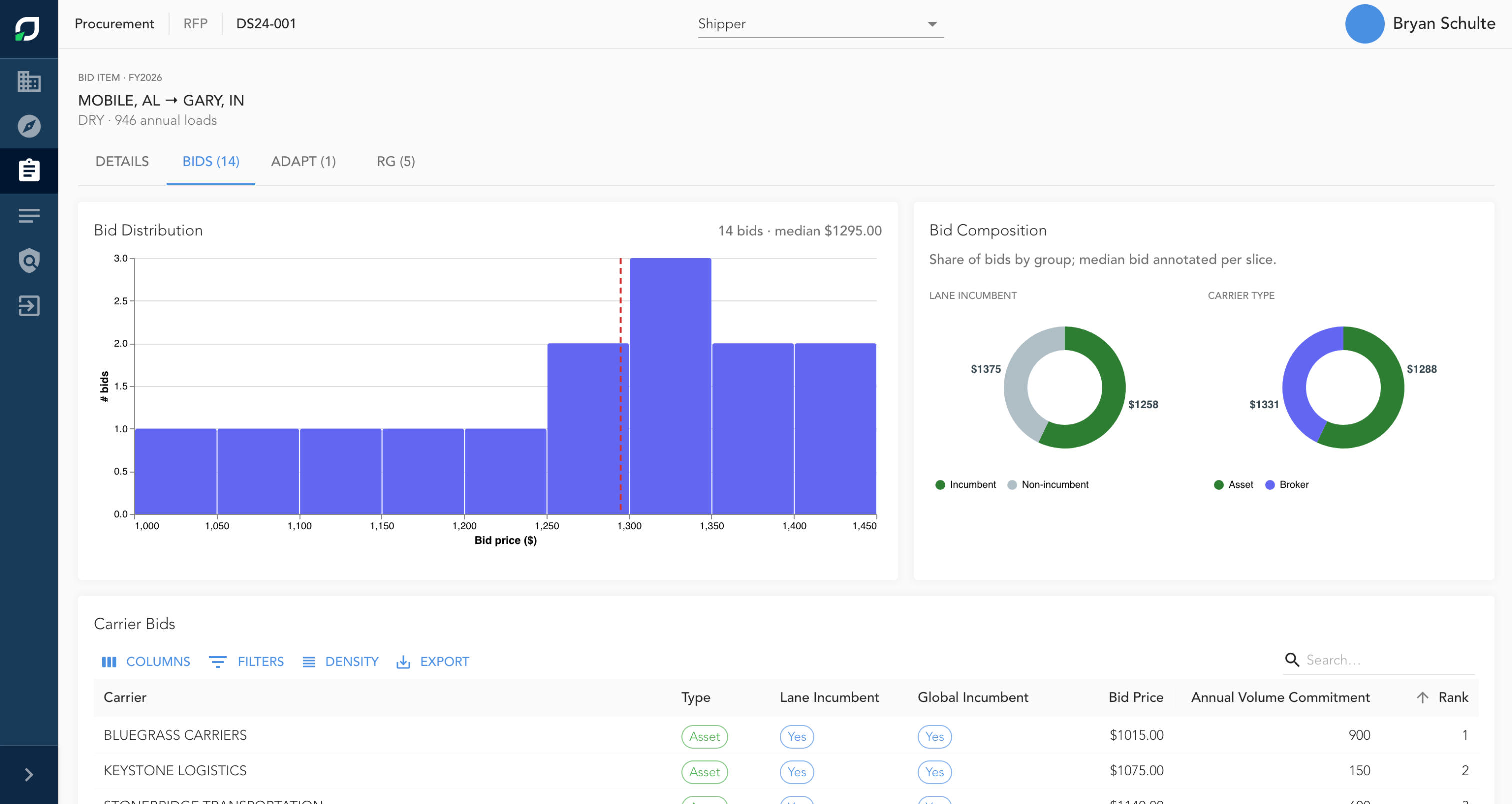
Understand the market expectations implicit in carriers' proposals, evaluate packages against lane-by-lane bids, and stress-test your award scenarios under a variety of market trajectories.
- Bid distribution and composition for every bid item
- Incumbent, asset and broker positions at a glance
- Award scenarios you can defend when the market moves
Catch risk early, and explain variance to budget
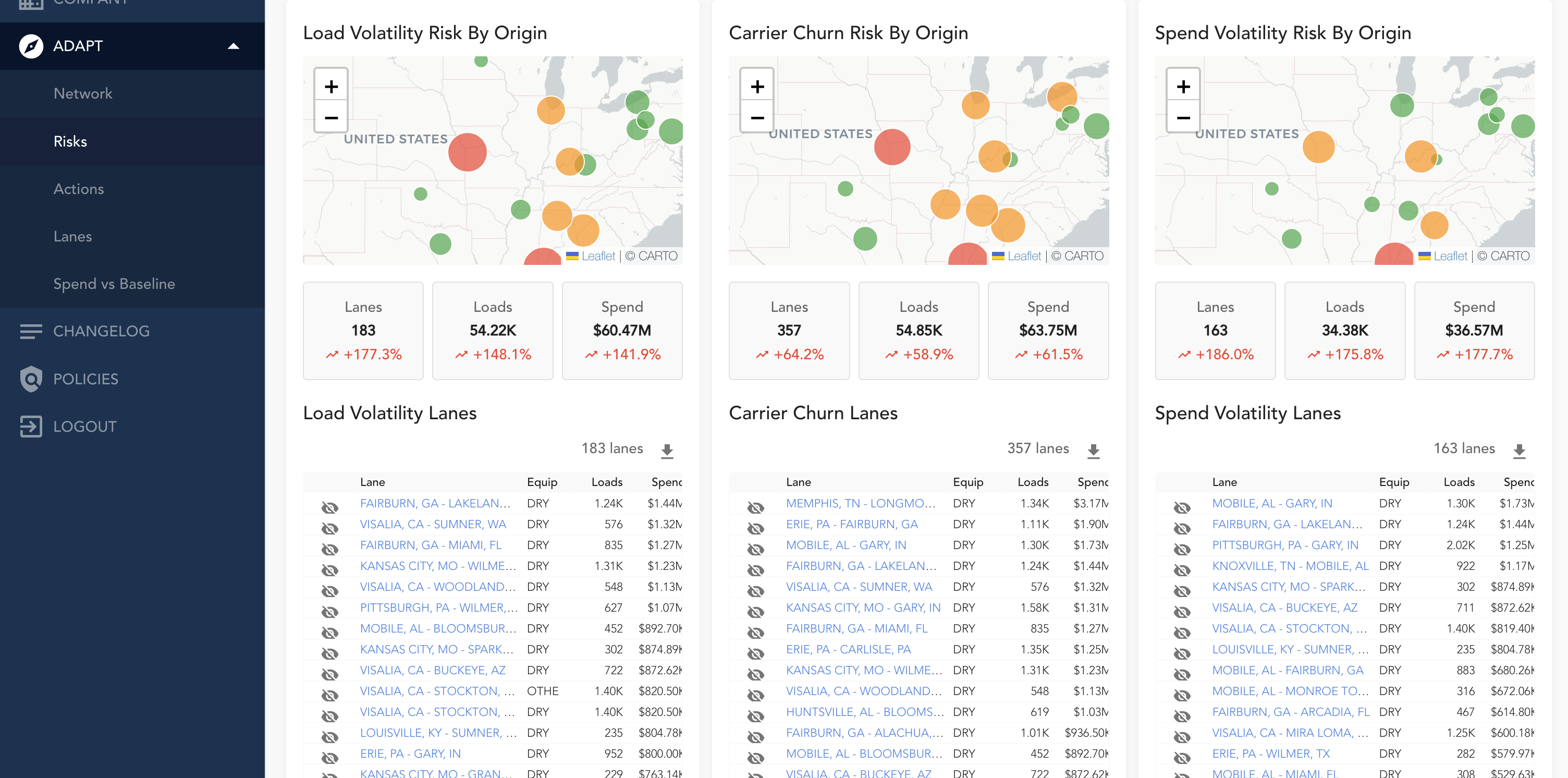
Monitor emerging cost and service risks before they become critical misses, and understand the sources of variance to budget. Adapt continuously monitors carrier digital twins to propose solutions to pain points in your network.
- Leading indicators: volume volatility, carrier churn, spend instability
- A recommended action for every at-risk lane
- Budget variance split into volume, mix, price, fuel and fixed
Freight spend: budget to actuals
- Volume
- Network mix
- Same-lane price
- Fuel
- Fixed (dedicated)
- Plan total
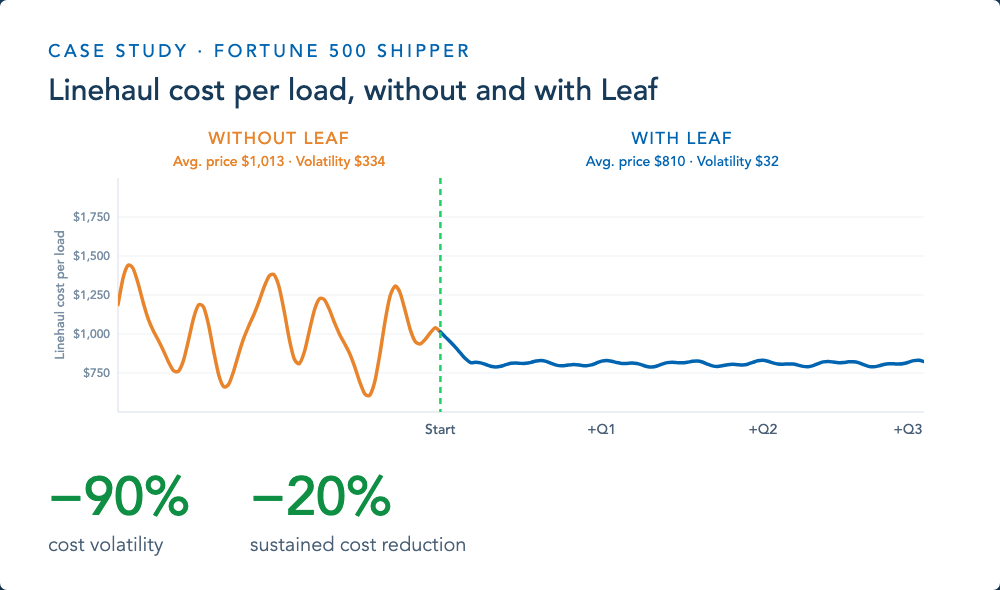
Lower cost, and far less volatile.
A Fortune 500 shipper moved a lane onto coordinated contract plans. Cost volatility fell 90%; average linehaul cost fell 20%. Across a portfolio, Leaf's approach has delivered 10%+ linehaul savings and up to 76% fewer empty miles.
Shippers across the country.
“We’ve been working with Leaf since 2018, enhancing service to our customers and increasing predictability for our carrier partners. Using Leaf as a “logic layer”, we plan to further automate transportation decision making, systematically reducing manual effort and eliminating empty miles across our network as we work towards our goal of a carbon-neutral supply chain.”
What to expect.
Is Leaf a TMS, an RFP tool, or a broker?
Can we keep working with our existing carriers?
What data do you need to start?
How quickly do results show up?
Can Leaf work with our existing carriers?
One of the benefits of working with Leaf is being able to use your preferred carriers. We’ll optimize your freight portfolio for your current carrier network and then fill any gaps.
Why does Leaf need our freight spend data?
Leaf offers shippers lower rates and better service by building multi-shipper circuits. In order to see how your freight can fit into these circuits, we need to analyze your historical freight data.
Getting started is easy, no matter where you are in your procurement cycle.
Share your data under NDA. We run it through Adapt and review the portfolio plan with you.
Get a complimentary assessment